


Spring 2025 Graduating Student Profile
William Carson
PhD in Health Behavior Health Promotion
Public Health Doctoral Student Fostered Engagement and Inclusion for Indigenous Students
William Oyenque Carson, a member of Ohkay Owingeh, graduated with his PhD in Health Behavior Health Promotion. During his time in the college, William expanded participation in the IndigiWellbeing event series that brings Native creators from around the country to the UA campus for engagement events. He also helped revive the annual PowWow event at the university and focused his doctoral work on health and wellness for Indigenous students.
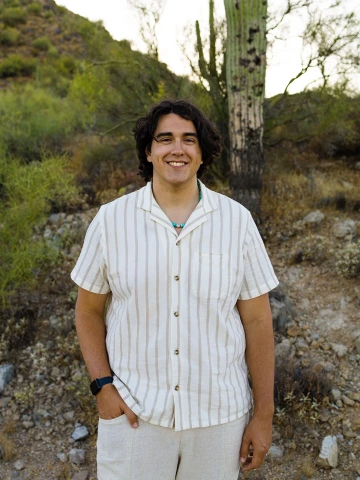
William Carson
PhD in Health Behavior Health Promotion
William Oyenque Carson, a member of Ohkay Owingeh, graduated with his PhD in Health Behavior Health Promotion. During his time in the college, William initiated collaborations between students and regional organizations, especially among Indigenous students. He was a leader in the partnership with the Tucson Indian Center to restart the annual PowWow event at the university, and was on the planning committee for the PowWow every year. The PowWow provides cultural connection for Indigneous students across the university. William is one of two recipients of the 2025 Student Life Award.
In addition, William was the lead organizer for the IndigiWellbeing event series that brings Native creators from around the country to the UA campus for engagement events that benefit Indigenous students and the whole campus community. He increased visibility and participation in the series that nurtured the UA’s Indigenous student community.
In his dissertation work, William further pushed for positive change for students. He worked with Campus Health and UA Indigenous organizations to develop programs that help Indigenous students to access campus healthcare services, thereby fostering Indigenous identity and persistence towards degree completion.
Thank you William for all you have done to enhance our college and our campus community and Congratulations!
For this profile, we asked William about what shaped his experience in the college as he pursued his doctoral degree.
Q: In addition to your classes, what projects or programs did you work on while earning your degree?
A: I served as Program Coordinator for the IndigiWellbeing program, a program focused on wellness that is grounded in Indigenous knowledge/cultures. In the university setting, IndigiWellbeing provides Indigenous students, and all others who are interested, programming that increases community and cultural connections. We have been able to bring in Indigenous presenters from all types of fields, ranging from authors, chefs, and fitness instructors to researchers and artists.
While here, I also worked with Indigenous students all across the university to restore the University of Arizona Pow Wow. The event had not occurred for over a decade, so over the course of several months, I organized all the active Indigenous student organizations on campus to work with the Tucson Indian Center to bring their Pow Wow to the university.
My dissertation is titled, “Exploring the relationship of Indigenous identity, perceived stress, and healthcare utilization among Indigenous identifying students attending the University of Arizona,” and aimed to understand why Indigenous students have the lowest rates of healthcare utilization at Campus Health in comparison to all other racial and ethnic groups.
Through the use of a mixed-methods approach (surveys and talking circles), this study explored the relationship between Indigenous self-identity, perceived stress, and utilization rates of on-campus healthcare among University of Arizona Indigenous students. The results of the study provide information that may assist the University of Arizona to develop future programs that aide Indigenous students to access campus healthcare options by incorporating Indigenous identity into more healthcare and support services.
Q: What inspired you about the projects or programs you worked on? What did you learn?
A: Every year since I have been on campus, IndigiWellbeing has organized two events in recognition of Missing and Murdered Indigenous People National Day of Awareness. We host a Missing and Murdered Indigenous Peoples (MMIP) Symposium and a 5k Run/Walk to bring awareness, offer healing and community, and advocate for change. These events draw hundreds of attendees each year and would not be possible without the incredible planning committee that organizes it. From these events I have learned about the importance of bringing in community partners as active members to help shape our events. Each organization on the committee brought something unique that strengthened the events.
This work then led me to realize that engaging community members also works on college campuses and immediately after the second year of MMIP events, I worked to organize our student groups in a similar manner to bring large events celebrating Indigenous people back to campus. We worked together towards our goal and eventually got there, with the hope that the revived UA Pow Wow will continue for years to come. These experiences not only led me to be part of incredible events but also made me a better researcher.
Q: Did you have a teacher or mentor who especially inspired you?
A: I am grateful for my main advisors, Felina Cordova-Marks and Stephanie Carroll, who both helped me learn and implement Indigenous research methodologies, and also taught me about the intricacies of being an academic. I also want to thank Ronald Trosper, Professor of American Indian Studies, who guided me to hone my work while in his class. Thanks to John Molina who has been an incredible mentor and helped me understand the policy world. Also thank you to Jean McClelland, Priscilia Magrath, Maia Ingram, Jennifer Bea, and Paloma Beamer for always being open to talk about school, life, and anything else while on campus.